

Princeton Theological Seminary Students’ Digital Humanities Projects
About Digital Humanities at Princeton Theological Seminary
What are the digital humanities and how are they part of seminary education? Princeton seminarians recently explored these and other questions to propose new interactive knowledge resources.
Scholarship in the digital humanities uses emerging information technology tools and methods, such as text encoding and geographic information systems, to interrogate and create new knowledge from digitized and born digital materials. Those materials might include digitized manuscript collections of 18th century theologians, high-resolution images of ancient paleographic specimens, or audio files on social media platforms. DH research mines data in humanities resources in ways not possible with traditional analog material.
At the same time, digital humanists query the technologies they use, examining possible ethical ramifications of these new trends in scholarship. Engagement and exchange are essential to the digital humanities.
Teaching and research at Princeton Theological Seminary have always been grounded in the humanities, all of which are digital now in some aspects. Discussions among PTS faculty, administrators, and library staff generated ideas for an introductory course in DH. F.W. “Chip” Dobbs-Allsopp, Associate Professor of Old Testament; Gregory Murray, Head of Digital Initiatives at the Seminary Library; and Andrew Newgren, Director of Academic Technology; co-taught the class in January and plan to teach it again January 2016.
“As with any other research design or skill, DH tools will suit some tasks and subjects better than others,” writes Professor Dobbs-Allsopp. “DH must be applied and adapted to specific issues and areas of research. As important, to exploit DH capacities fully, whether in teaching or research, scholars must know what kinds of skills are required. There is no ‘DH’ anything specific to Biblical Studies. However, I can imagine a number of ways DH methods can enhance and lead to deeper projects in the history of the Bible. I’m sure the same is true for all other disciplines represented at the Seminary.”
As PTS Senior Michael J. Toy writes in his paper on digital confessions, “The ubiquity of digital technology, the increase in computing power, and the ability to perform metadata analysis open up new doors, new questions, and new challenges to religious studies.”
Love of God Audio Quotation Database

The Love of God (L.O.G.) Audio Quotation Database is an example of teaching the digital humanities due to its focus on creating an engaging learning process using digital audio and the humanities. Teaching the digital humanities is further discussed in the open-source textbook, Debates in the Digital Humanities edited by Matthew K. Gold, which was our main text for the Introduction to Digital Humanities course and workshop at Princeton Theological Seminary.
This digital humanities project features the practice of informal education for a high school youth group. Rev. Katie Mulligan supported my efforts to facilitate this project by providing the high school students she serves at L.O.G. of New Jersey with time to participate in this project within the context of their regular youth group programming. These high school students researched and selected quotes about love and God that fostered ongoing personal reflection and group discussion for their youth group. This project also provided students with an experience where they could develop their speech communication skills as they made audio recordings of selected quotes with their own voices.

Each recording includes:
- A clearly stated quote.
- The full name of the quote’s original author and the context in which it was discovered.
- An explanation of the important lesson the quotation has for L.O.G. about love and/or God.
The importance of the quote is that it shows the love of God shines through all of our hearts.
Youth group members used their own recording devices (laptop computers, smartphones, etc.) to create their audio quotations. They then saved the recordings in MP3 file format with the following title form:
Youth group member’s first name – Love of God Quote – Date
Recordings range from 30-60 seconds and are made in a quiet setting. Audio files were sent by email attachment to logaudioquotes@gmail.com for review. After review, the recordings were uploaded to the database in Tumblr, the microblogging platform and social networking website.
This quote relates to L.O.G. because God is there for us (L.O.G.) in good and bad situations. We know this through Jesus, God’s son.
In summary, this project has provided a new process for data collection and education for L.O.G. of New Jersey as they continue to create more digital audio of quotes from the humanities to explore varied understandings of love and God.
— Jeffrey Cobbold
Digital Humanities and Text Encoding

The DH community has been working for decades to make digital versions of texts widely available in forms that honor their physical counterparts but also allow for digital manipulation. The most common and accepted solution to this problem has been the guidelines set out by the Text Encoding Initiative (TEI). TEI is a set of XML schemas specifically designed for the encoding of archival quality digital editions. TEI encoded documents are behind the scenes in many DH projects with a broad range of applications and implications.
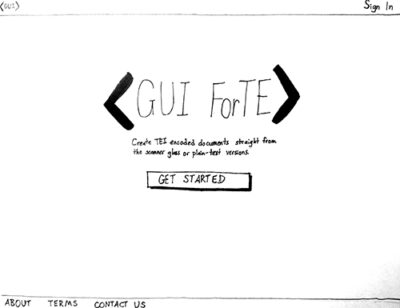
To create a digital edition, a person must (1) have an adequate level of genre subject knowledge, (2) be proficient enough with XML to encode, and (3) have the time and/or resources to do so. Some people have tried to streamline this system by delegating the encoding to interns or assistants, sacrificing granularity in markup, or just using plaintext versions of texts. The lack of available texts and the learning curve required to create such texts continues to be an Achilles’ heel of DH work.
I proposed a software package that would essentially turn encoding into a point-and-click exercise. This type of software would eliminate the need for scholars in the humanities to familiarize themselves with XML, would change the technical language from XML to the particular field of study, and would be faster and easier to work with than a text editor.
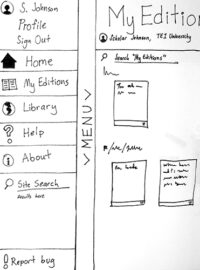
Paper prototyping is a rapid prototyping method used in software development to help refine software flow. In paper prototyping, everything that may be displayed on a screen is instead drawn on paper including pop-up boxes, menus, etc. A developer and a test user sit down together at a table. The test user uses their finger as a mouse, and the developer moves and changes the sheets to mimic the way the software would actually work.
My project employed paper prototyping and video-taped usability studies. Test users were given background about the project and method before being asked to test the prototype with audible real-time commentary on their thoughts and reactions.

All things considered, the amount of functionality afforded by a paper prototype was successfully communicated to the test users, who were then able to leverage that functionality towards the expected ends. The paper prototyping and usability studies show that the software approach to encoding works in theory: the real issue to be considered is proper development of the core functionality, not the feasibility for end users. The next primary testing objective would need to be an alpha test of a computer prototype of the basic functionality.
– Alan B. Thorne, Jr.
SPACER
Father Forgive Me for I Have Trolled

Today, if you ask any Roman Catholic or Anglican priest about their parishioners’ frequency of practicing confession, he or she would almost certainly tell you that there has been a decline in the number of those who come to the confessional. Statistical research from one Georgetown report supports this observation of the decline of confession in the church.

While ecclesial confessions are certainly performed by fewer and fewer people, digital technology has opened the floodgates to a new kind of anonymous confession. Before we can analyze the confessions, we must analyze these ersatz confessionals in the digital realm.
This project seeks to deepen our conception of the study of religion through a re-imagination of religious scholarship in a digital age. The first section of the essay will address the problem that anonymity and automation prevents data in the digital sphere from necessarily corresponding to activity in the physical sphere within which human beings live, breath, talk, and act. Next, we will examine possible solutions to this problem of mapping humans to digital activity. To ground theory in practice, we will explore the way forward through analysis of digital confessions through the lens of Foucaultian power structures and media effects.

Yik Yak is a mobile app released in November of 2013 that allows users to post anonymously. While many posts are about banal or trivial things, Yik Yak has made the news for being a vehicle for cyber bullying. This is one example of a confession by a student expressing guilt for inaction while a friend suffers a breakdown.

In PostSecret, members of a community reveal information about themselves as a way to contribute to the digitally public intimate economy (Poletti, 2011). This contribution allows them to participate in the community, assuaging the desire of guilt or shame with the feeling of belonging and acceptance. This is not dissimilar to a Christian theology of confession. For some Roman Catholics, confession is a necessary step one must take before participation in communion or Eucharist. Lutheran theologian Dietrich Bonhoeffer writes in Life Together (1954) that it is the act of confession of sins that breaks down the walls that prevent fellowship or true Christian community (p. 110).
Many of these confessions are sexual in nature, falling into a pattern that Michel Foucault (1978) notes has been occurring since the beginnings of the church, “From the Christian penance to the present day, sex was a privileged theme of confession (p. 61).”
Reddit is an internet community that allows for users to post content, reply, and up-vote or down-vote existing content. The only thing needed for an account is an email address, and many Redditors use “throwaway” accounts for sexual solicitation or confession. On the confession thread, or subreddit as it is called, there are three categories for posts.
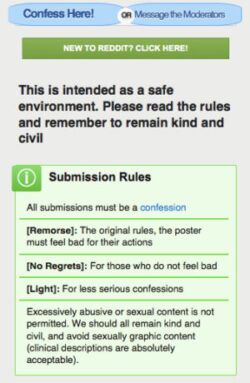
On the surface this seems like an ideal example of an internet confession with strong analogy to ecclesial confession in which the confessor received validation and acquittal of shame, along with advice for future action. The only problem is that due to the nature of the site, there is no evidence that this is actually a real person or someone who is merely fabricating the whole thing. The Internet is full of trolls, and Reddit is not an exception.
As Christianity plunges further into a digitally saturated environment, pastors and theologians alike must take heed of the changing landscape of confession, remaining ever aware of the Church body’s psychological, pastoral, and theological needs.
– Michael J. Toy